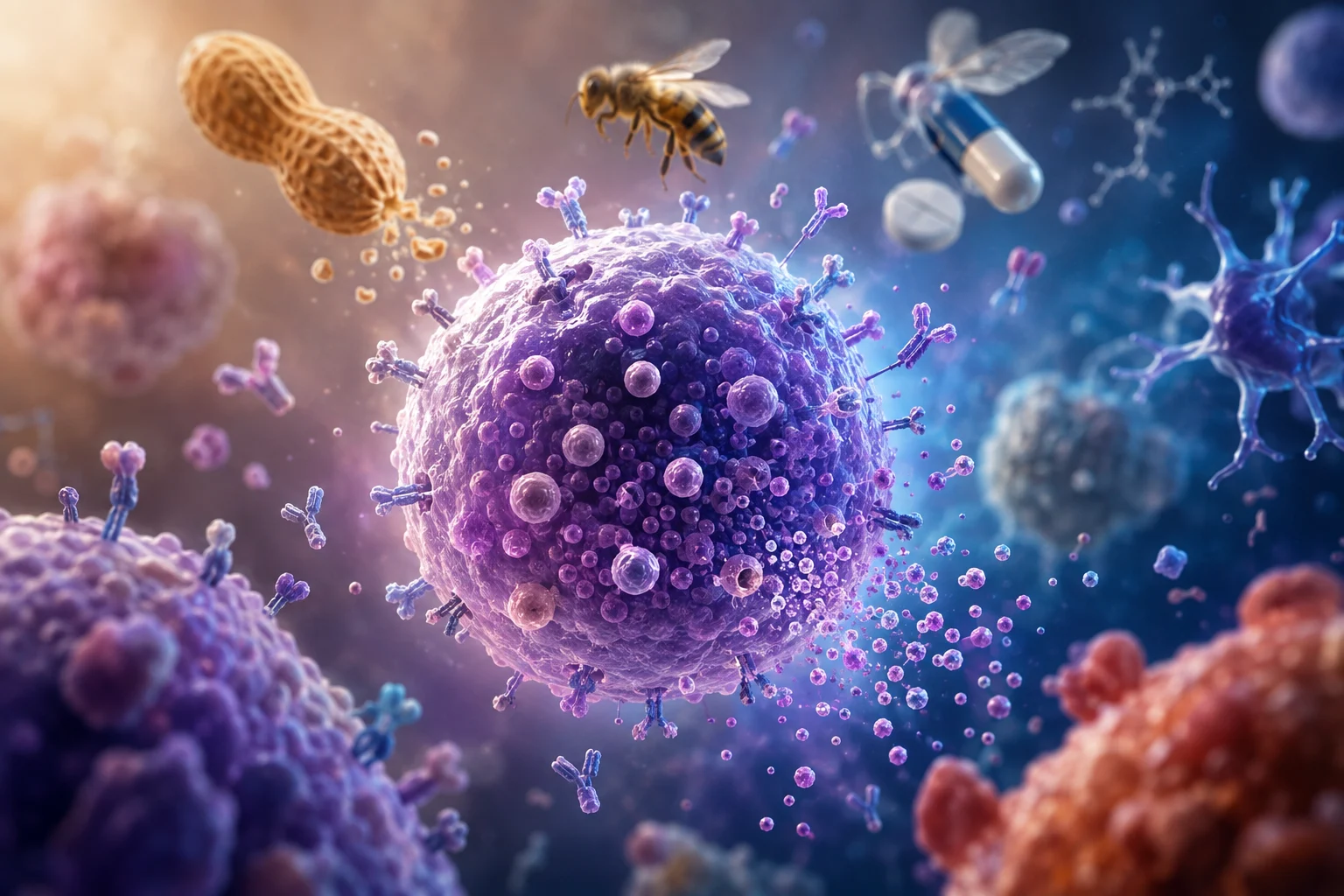
Different triggers. Different diseases. A common cellular driver.
Anaphylaxis can be triggered by foods, insect venom, medications, or—in some patients—no identifiable trigger at all. Yet despite this remarkable diversity, many severe allergic reactions converge on a common biological event: activation of the mast cell.
A comprehensive review by Theo Gülen, M.D., Ph.D., and Cem Akin, M.D., Ph.D., published in Immunology and Allergy Clinics of North America, examines the relationship between anaphylaxis and mast cell disorders and highlights just how central mast cells are to severe systemic allergic reactions.
For AllerGene AI Therapeutics, this biology raises an important therapeutic question:
If many different allergic triggers ultimately converge on the mast cell, could targeting the disease-driving cell itself provide a fundamentally different way to treat allergic and mast cell-mediated diseases?
Mast cells are more than a source of histamine
Mast cells are long-lived, tissue-resident immune cells found throughout vascularized tissues, particularly at interfaces with the external environment such as the skin, respiratory tract, and gastrointestinal tract.
They are designed to respond rapidly to danger.
When activated, mast cells can release a powerful mixture of preformed and newly generated mediators, including histamine, tryptase, prostaglandins, leukotrienes, proteases, and inflammatory cytokines. When this activation becomes widespread and excessive, the consequences can include hypotension, bronchospasm, gastrointestinal symptoms, syncope, and potentially life-threatening anaphylaxis.
Importantly, mast-cell activation is not limited to the classical IgE-allergen pathway. Gülen and Akin describe multiple mechanisms capable of activating mast cells, including IgE-dependent and non-IgE-dependent pathways.
This distinction is important.
It means that different triggers can activate different upstream pathways while ultimately converging on the same downstream effector cell.
The trigger can change. The mast cell remains.
Mast cell disorders reveal what happens when this system becomes dysregulated
The connection between mast cells and anaphylaxis becomes particularly apparent in mast cell disorders.
Systemic mastocytosis is characterized by the abnormal accumulation and activation of clonal mast cells in tissues. The review describes the strong association between mastocytosis and severe anaphylaxis, particularly reactions associated with Hymenoptera venom.
The authors also discuss monoclonal mast cell activation syndrome, mast cell activation syndrome (MCAS), hereditary alpha-tryptasemia, and idiopathic anaphylaxis—illustrating the biological and clinical complexity underlying severe mast-cell activation.
One particularly important lesson is that the severity of anaphylaxis may depend not simply on exposure to an allergen, but on characteristics of the mast cells themselves.
The number of mast cells, their activation state, their propensity to release mediators—or “releasability”—genetic factors, coexisting allergies, and other patient-specific factors may all influence the severity of a reaction.
In other words, the mast cell is not merely a passive endpoint in allergy. The biological state of the mast-cell compartment may be a major determinant of disease.
Current treatment primarily controls the reaction
For acute anaphylaxis, intramuscular epinephrine remains lifesaving and is the treatment of choice. The authors emphasize that despite its importance, epinephrine continues to be underutilized.
Long-term management of mast cell-mediated disease can involve combinations of antihistamines, leukotriene-directed therapies, mast-cell stabilizing approaches, anti-IgE therapy, trigger avoidance, and—in appropriate forms of systemic mastocytosis—therapies directed against KIT or aimed at reducing mast-cell burden.
These approaches have transformed patient care and remain critically important.
But the biology described by Gülen and Akin also suggests an opportunity to think differently.
Much of allergy treatment has historically focused on either avoiding the trigger, interrupting an upstream activation pathway, or blocking the mediators released after mast-cell activation.
What if it were possible to intervene at the level of the disease-driving cell?
From targeting mediators to targeting the cellular source
This is the scientific premise behind AllerGene AI Therapeutics.
AllerGene is developing an investigational in vivo mRNA CAR-T platform designed to selectively target mast cells. Rather than manufacturing CAR-T cells outside the body, our approach is being developed to use targeted lipid nanoparticles to transiently program immune cells directly in vivo.
The goal is to create a controlled population of transient CAR-T cells capable of recognizing and eliminating disease-relevant mast cells.
This represents a fundamentally different therapeutic hypothesis.
Instead of designing a treatment around each individual allergen or blocking one mediator at a time, targeting the central effector cell could potentially provide a trigger-agnostic approach to mast cell-driven disease.
The concept could ultimately have relevance across multiple diseases in which inappropriate mast-cell activity plays an important role, including mastocytosis, chronic urticaria, severe food allergy and anaphylaxis, mast cell activation disorders, and other allergic diseases.
These diseases are biologically distinct, and they should not be considered interchangeable. But they share something important: the mast cell.
Why use transient mRNA CAR-T cells?
CAR-T technology has demonstrated that immune cells can be programmed to selectively recognize and eliminate defined cellular populations.
For allergic disease, however, permanently engineered CAR-T cells may not be necessary—or desirable.
AllerGene’s platform is being developed around mRNA, which produces temporary rather than permanent CAR expression. This creates the potential for a pharmacologically controlled period of CAR-T activity without permanently altering the patient’s T cells.
Our objective is not continuous immune-cell engineering. It is a transient intervention intended to selectively reduce the disease-driving cellular population and potentially allow a healthier mast-cell compartment to re-emerge over time.
This strategy remains investigational and is currently being evaluated preclinically. Demonstrating appropriate target selectivity, efficacy, dosing, and safety will be essential before determining whether this biological hypothesis can translate into patient benefit.
A different way to think about allergic disease
The Gülen and Akin review View on PubMed provides an important perspective on anaphylaxis: severe allergic reactions are not defined solely by the substance that triggers them.
The underlying state, number, and behavior of mast cells matter.
That insight has implications well beyond mastocytosis.
Food allergens, venom, drugs, antibodies, complement pathways, and other stimuli may initiate reactions through different mechanisms. But when those signals converge on mast-cell activation, the mast cell becomes a compelling point for therapeutic intervention.
At AllerGene, we believe this creates an opportunity to explore a new therapeutic paradigm:
Different triggers. Different diseases. One central cellular driver.
Rather than continually managing what happens after mast cells become activated, we are investigating whether the disease-driving mast cells themselves can be selectively and transiently eliminated.
If successful, this approach could shift the treatment of mast cell-mediated disease from repeated suppression of allergic reactions toward addressing a cellular source of the disease.
That is the future we are working to build.
Reference
Gülen T, Akin C. Anaphylaxis and Mast Cell Disorders. Immunology and Allergy Clinics of North America. 2022;42(1):45-63. doi:10.1016/j.iac.2021.09.007. View on PubMed.
AllerGene’s therapeutic platform is investigational and is currently in preclinical development. It has not been approved for the treatment or prevention of any disease.